

Bridging Mind, Brain, and Fluency by Understanding Psycholinguistics and Multilingualism
The Dawn of Dialogue
Human speech in its current form began approximately 50,000–150,000 years ago. Before this shift, we relied on protolanguage: a raw, holistic blend of grunts, gestures, and rhythms without the structured syntax we rely on today.
Modern language has achieved remarkable efficiency. Speaking or comprehending a single word demands massive brainpower that matches today’s leading AI systems, yet consuming only about 20 watts of energy. Every syllable arrives as a precise data packet, decoded instantly by the universe’s most advanced biological machine: the human brain.
Understanding Psycholinguistics
The field’s name reveals its hybrid nature, acting as a mid-20th-century bridge between linguistics and psychology.
- Psycho-: From the Greek psyche (“breath,” “spirit,” or “soul”), referring to mental processes.
- Linguistics: From the Latin lingua (“tongue” or “language”).
While the term was coined by Jacob Robert Kantor (1936) and popularized by Nicholas Pronko (1946), the field was formally established in 1954 by Charles E. Osgood and Thomas A. Sebeok.
Core Definition: Psycholinguistics studies the psychological and neurobiological processes that allow humans to acquire, produce, and comprehend language. It explores how the mind transforms sounds or signs into meaning.
Pillars of Research
| Area | Focus | Key Debate/Theory |
| Acquisition | How children learn language | Nature (Innate) vs. Nurture (Learned) |
| Comprehension | Decoding words and syntax | “Garden-path” vs. Interactive models |
| Production | Turning thoughts into speech | Studied via “slips of the tongue” |
| Neurolinguistics | Brain structures involved | Aphasia studies and neuroimaging (fMRI, ERP) |
Developments in Psycholinguistics:
Contemporary research in the field employs advanced methods like eye-tracking and AI modeling to explore linguistic relativity, the ways language influences perception and cognition, and the cognitive benefits of bilingualism, such as enhanced executive function and mental flexibility.
1. The Seep-In Effect: AI is Rewriting Our Internal Vocabulary
Recent research (notably from 2024 and 2025) has identified a phenomenon called the Seep-In Effect. Because we interact with Large Language Models (LLMs) like ChatGPT so frequently, the specific, robotic linguistic patterns of AI are beginning to migrate into our organic, everyday speech.
- Interesting Fact: Words like “delve,” “intricate,” “underscore,” and “surpass” which are statistically overrepresented in AI training data, have seen a massive spike in natural human conversation and academic writing.
- The Outcome: We aren’t just using AI to write; we are subconsciously “fine-tuning” our own brains to match the AI’s statistical distribution of words. Psycholinguists worry this is leading to linguistic homogenization, where the unique texture and grit of individual human voices are being smoothed over by an efficient, machine-generated mold.
2. Metacognitive Atrophy: Let’s not Loose the Ability to Know What We Know
For decades, psycholinguists studied how the brain performs a “gut check” to see if it truly understands a concept. This is called metacognitive monitoring. New studies in 2025 show that heavy AI use is dulling this internal alarm system.
- The Finding: In controlled experiments, students using AI could answer 48% more questions correctly than those without it. However, when the AI was removed for the final exam, those same students scored 17% lower than the group that never used AI at all.
- The Outcome: The users weren’t just “outsourcing” the work; they were suffering from a metacognitive blind spot. They felt more confident than ever, yet their actual neural retention was at an all-time low. Their brains had stopped engaging in the “effortful learning” required to move information from short-term processing to long-term memory.
3. The Connectome: The Brain’s Living Circuitry
A connectome is a comprehensive map of the neural connections in the brain; essentially the wiring diagram of every thought, emotion, and word we possess. It is the architectural blueprint of the human experience.
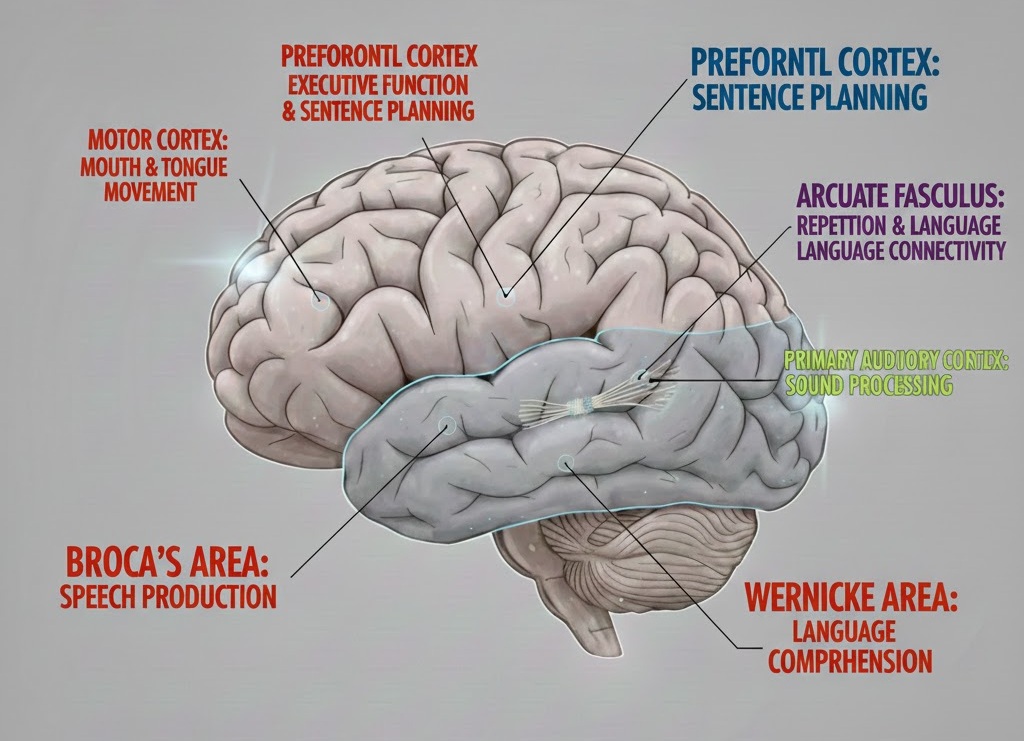
For decades linguist believed language was confined to specific hubs like Broca’s or Wernicke’s areas. However, using high-resolution fMRI and EEG co-registration, researchers have discovered a more profound truth: Language is a whole-brain event.
4. Neural Mirroring: Language Simulation
When we engage with language, our brain doesn’t just decode symbols; it mimics the actions described.
- Action Words: When we hear the word “kick,” our motor cortex (the region responsible for moving your legs) physically fires.
- Sensory Descriptions: When we read a vivid description of a sunset, our visual processing centers light up as if the light were actually hitting your retinas.
- Olfactory Language: Mentioning the scent of lavender or coffee can trigger the olfactory bulb and related sensory regions.
This reveals that language is a physical simulation. The brain recreates the sensory experience in real-time. This discovery bridges linguistic symbols and biological reality, suggesting that to understand a word is to feel its meaning within the body.
The Nature of the Mind: Individual or Shared?
A deep question in the field is whether the mind is a private realm or a shared space. If the brain is the hardware (neurons and lobes), the mind is the software—our conscious experience.
Neural coupling creates a functional link where brain activity between subjects synchronizes in tandem, essentially allowing people to share thoughts across individual biology through a unified mental space. This “brain-to-brain” connection occurs naturally during deep communication as psycholinguistics reveals that a listener’s brain activity mirrors and aligns with the speaker’s in real time, particularly within regions governing language and emotion. When this happens, the participants effectively share the same vibration or frequency, allowing for a collaborative processing of information where the listener’s neural patterns become an echo of the speaker’s own.
The Classroom Connection
Neural coupling is especially sensitive in language learning:
- L1 (Native Language): Coupling is strong and immediate due to low cognitive load.
- L2 (Target Language): Coupling can fragment if input is too complex.
- Optimal Instruction: In the upcoming webinar, Jason R. Levine will discuss “scaffolding,” where the teacher’s neural patterns lead slightly ahead, guiding the learner’s brain toward fluency.
The Challenge of Second Language Acquisition (SLA)
Adult L2 learning differs sharply from childhood acquisition due to:
- Language Transfer: L1 patterns “leaking” into L2.
- Cognitive Load: The heavy working memory demanded by new languages.
- Critical Period: The debate over childhood brain plasticity and native-like mastery.
The Multilingual Advantage: Executive Function
Executive function is a set of mental skills that act as the “management system” of the brain, allowing you to plan, focus attention, and juggle multiple tasks simultaneously. It enables you to filter distractions, prioritize goals, and control impulsive responses in order to achieve long-term objectives. This system is supported by an innate “Universal Grammar,” a biological template that pre-tunes the neural circuitry to the structural patterns of all human languages.
Multilingualism strengthens this “mental traffic control” by forcing the brain to manage these competing linguistic structures. Because multiple languages remain active, the brain must constantly inhibit the one not in use. This “workout” boosts:
- Cognitive Flexibility: The ability to switch between different rules or tasks.
- Inhibitory Control: The power to ignore “noise” and focus on relevant information.
- Working Memory: The capacity to hold and manipulate information in real-time.
Psycholinguistic Synthesis
Many multilinguals feel like a “different person” in each language—perhaps more assertive in one and more poetic in another. Psycholinguistic synthesis is the advanced goal of integrating these personas for unified self-expression, reducing cognitive friction, and achieving an authentic identity regardless of the language spoken.
The Great Psycholinguistic Debate: Skinner vs. Chomsky
This psycholinguistic clash of academic titans fueled the Cognitive Revolution, moving the field from Skinner’s “black box” approach to Chomsky’s study of internal structures. By treating the mind as an information processor similar to a computer, researchers began mapping how we acquire language, solve problems, and store memories through complex mental architectures.
A second Great Cognitive Leap may be on the horizon as the boundary between biological and artificial intelligence blurs, potentially shifting our focus from how the mind works in isolation to how it integrates with external neural interfaces and synthetic cognition. This future shift could redefine “thought” itself, moving us away from purely organic processing toward a hybrid model of augmented intelligence.
| Feature | B.F. Skinner (Behaviorism) | Noam Chomsky (Innatism) | The Great Cognitive Leap (Augmented/Hybrid) |
| Core Theory | Verbal Behavior (1957): Learned habit | 1959 Review: Innate faculty | Distributed Cognition (2020s+): Hybrid systems |
| Mechanism | Operant conditioning (rewards) | Language Acquisition Device (LAD) | Neural Interfaces & Large Language Models (LLMs) |
| Input Role | Environment provides all knowledge | “Poverty of the Stimulus” (Trigger only) | Big Data & Symbiotic feedback loops |
| Universal Grammar | Does not exist | Innate rules for all languages | Statistical probability & Emergent logic |
| View on Errors | Bad habits to be corrected | Evidence of rule application (e.g., “I goed”) | Hallucinations or “Beige” algorithmic drift |
Current Modern Perspectives Blend Both Views: Linguist acknowledge the brain’s specialized architecture (Chomsky) while recognizing that powerful statistical learning from experience (Skinner) builds our neural networks.
Join Us and Learn More
Join us on March 19th at 10:00 AM EST to explore these concepts in depth with Jason R. Levine (Fluency MC), an expert in the intersection of rhythm, psychology, and rapid acquisition. This webinar is open to the public, and a part of ATI’s TESOL Advanced Certification Program.