
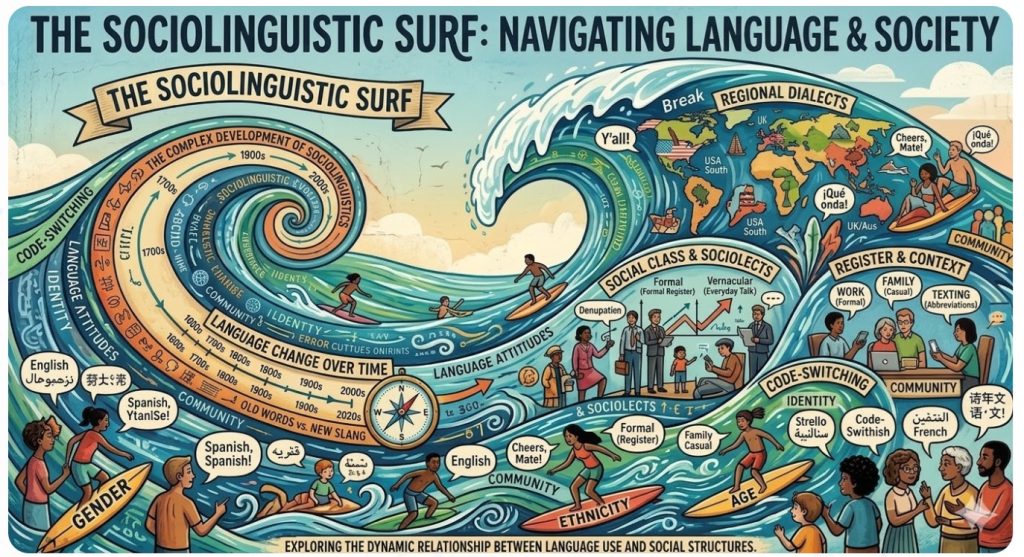

Ready to catch the wave? Join us live April 16th at 10 AM EST and dive into the Sociolinguistic Surf with Jason R. Levine (Fluency MC). This webinar is a core component of American TESOL Certification Courses, and all are welcome to attend.
What is Sociolinguistics?
Sociolinguistics can be understood by first identifying socio-, from the Latin socius meaning “companion, ally, or associate,” which eventually evolved in Social Sciences to refer to society or the collective community; and linguistics from the Latin lingua, meaning “tongue” or “language.”
When you fuse these two roots, the term literally translates to the study of “language in companionship” or, more formally, the scientific study of how language functions within a society.
| Component | Root Word | Origin | Meaning |
| Socio- | Socius | Latin | Companion / Associate / Society |
| Linguistic | Lingua | Latin | Tongue / Language |
| -ics | Ikos | Greek | Pertaining to / The study of |
Why Does Sociolinguistics Matter in TESOL?
If standard linguistics is the “code” of a language (the vocabulary and the grammar), sociolinguistics is the study of how that code changes based on who is speaking, where they are speaking, and why they are speaking.
Linguistics might teach you that “He is happy” and “He is pleased” are both grammatically correct. A sociolinguist will tell you:
- “He is pleased” is more appropriate in a business report.
- “He is happy” is more appropriate in casual conversation.
- “He is soooo excited” might be used primarily by a younger demographic or in digital spaces.
Sociolinguistics provides the “social rules” of the language. Without these rules, a student might succeed on a grammar test but fail to navigate a real-life conversation, a job interview, or a social gathering.
The Three Lenses: Micro, Macro, and Meta
To understand the full scope of the field, we look through three different lenses:
- Micro-Sociolinguistics (The Individual “Vibe”): Focuses on small-scale mechanics like dialects and registers.
- The Question: “Why did this person use this specific word in this interaction?”
- Macro-Sociolinguistics (The Big Picture): Looks at entire speech communities, language planning, and global spread.
- The Question: “Why is English the global language of aviation?”
- Meta-Sociolinguistics (Talking About Talking): Deals with the “ideologies” and attitudes we have about speech.
- The Question: “Why is one accent perceived as ‘sophisticated’ while another is judged as ‘uneducated’?”
The “Super-Skill”: Code-Switching & Prestige
For English language learners, mastering linguistic shifts is a cognitive and social “super-skill.”
The Scenario: Marco’s Two Worlds
Imagine Marco, a bilingual software engineer in San Francisco. Within ten minutes, he performs a radical linguistic shift:
- In the Boardroom (Formal Register): While presenting to the CEO, Marco uses “Standard American English” to signal competence.
- Speech: “We have successfully optimized the backend architecture to reduce latency.”
- In the Breakroom (Informal Register): Moments later, he runs into a close colleague. To signal shared identity, he mixes Spanish and English (Spanglish).
- Speech: “Oye, the presentation went well, pero I was so nervous. ¡Qué alivio!”
In this sociolinguistic context, Register refers to the specific “gear” or variety of language a speaker shifts into based on the social situation, audience, and level of formality. Think of it as a linguistic costume that changes depending on the “stage” you are standing on. In the boardroom, Marco adopts a Formal Register, which prioritizes clarity, technical precision, and “Standard” grammar to project professional authority. In the breakroom, he shifts to an Informal Register, which prioritizes social bonding and authenticity through relaxed syntax and code-switching.
Mastering register is considered a “super-skill” because it requires the speaker to constantly read the room and adjust their vocabulary and tone to meet the unspoken social expectations of the group, ultimately determining how “competent” or “relatable” they appear to others.
Overt vs. Covert Prestige
- Overt Prestige: Using the “Standard” language to gain mainstream professional success.
- Covert Prestige (Solidarity): Using “insider” language (slang/dialects) to signal authenticity and trust within a specific group.
The Five Clocks of Formality
Developed by Martin Joos, the “Five Clocks” treats language like a thermometer. Just as you dress for the temperature, you “dress” your speech for the social climate.
| Register | Context | Key Characteristics |
| Frozen | Weddings, Law | Static language that never changes. |
| Formal | Speeches, Meetings | One-way communication; no slang. |
| Consultative | Doctor/Teacher | Professional back-and-forth. |
| Casual | Friends, Peers | Slang, “insider” references, dropped words. |
| Intimate | Family, Partners | Private codes and non-verbal cues. |
The Generational Evolution: 6 Waves
The evolution of sociolinguistics reflects a transition from seeing language as a rigid reflection of status to a fluid tool for neural and digital identity. Learn more about the 6 Waves of Sociolinguistics.
| Wave | Era | Cohort | Core Theory | Primary Focus |
| Wave 1 | 1970s–80s | Boomers | Variationism | Correlating variables with class and gender. |
| Wave 2 | 1980s–90s | Gen X | Social Networks | Interpersonal ties and group membership. |
| Wave 3 | 1990s–00s | Millennials | Stylistic Variation | Individual agency and performative identity. |
| Wave 4 | 2000s–Pres | Gen Z | Multilingualism | Translanguaging and complex repertoires. |
| Wave 5 | 2030s+ | Gen Alpha | Digital Discourse | Viral evolution and social media patterns. |
| Wave 6 | Future | Gen Beta | Neural Frontiers | Theoretical bio-digital communication. |
Note on Demographics: The “Baby Boomer” generation is the only cohort formally recognized by the U.S. Census Bureau. Subsequent terms (Gen X, Millennials, etc.) originated from authors, researchers, and social commentators to categorize our changing social landscape.
Join the Webinar!
Join us for a special session with Jason R. Levine (Fluency MC) as we dive into the Sociolinguistic Surf! Don’t let your students get wiped out by the complexities of real-world English. Whether they are navigating the Overt Prestige of a job interview or seeking Covert Prestige among peers, they require the tools to transition between the 5 Clocks of formality and the evolving 6 Waves of our global culture.
Master the art of Code-Switching and transform your teaching into a dynamic, sociolinguistic experience. All are welcome, so grab your board and get ready to catch the Sociolinguistic Surf—we’ll see you there!