
Are Your Students Listening… or Just Waiting to Talk?
While “Listening” is a foundational skill in the four domains of language learning, it is often taught as a passive activity (listen, answer comprehension questions, repeat). This webinar shifts the paradigm. Join the American TESOL Institute and world-renowned language coach Jason R. Levine (Fluency MC) as we explore how the latest neuroscience regarding “Neural Coupling” and “Oxytocin” can be applied to create more effective, high-engagement listening activities in the ESL classroom.
The Neuroscience of Listening
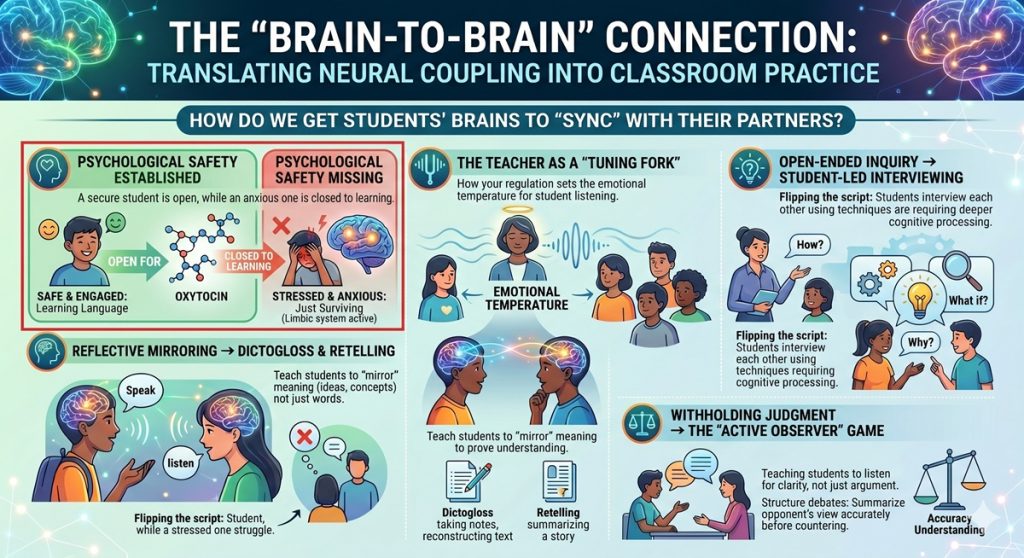
- The “Brain-to-Brain” connection: Translating Neural Coupling into classroom practice. How do we get students’ brains to “sync” with their partners?
- Psychological Safety: How the “Trust Hormone” (oxytocin) impacts language acquisition. If students are stressed, they are not acquiring language—they are just surviving.
- The Teacher as a “Tuning Fork”: How your regulation as a teacher sets the emotional temperature for student listening.
From Interpersonal Skill to Classroom Pedagogy
In this section, Jason R. Levine will break down the essential listening skills and demonstrate how to turn them into TEFL lesson components:
- Reflective Mirroring ? Dictogloss & Retelling: How to teach students to “mirror” the meaning (not just words) to prove understanding.
- Open-Ended Inquiry ? Student-Led Interviewing: Flipping the script. Moving from “Teacher asks questions” to “Students interview each other” using specific questioning techniques that require deeper cognitive processing.
- Withholding Judgment ? The “Active Observer” Game: Teaching students to listen for clarity rather than argument. How to structure classroom debates where the goal is to summarize the opponent’s view accurately before countering.
Live Demonstration & Rhythm
- Fluency MC Special Segment: Jason R. Levine demonstrates how rhythm, cadence, and “musical” listening can help students tune into the nuances of English prosody and intonation.
- Interactive Poll: Real-time feedback on the biggest “listening barriers” teachers face in their classrooms.
Q&A & Teacher “Takeaways
- Open floor for troubleshooting specific classroom scenarios.
- Downloadable PDF: “5 Listening Warm-ups based on Neuroscience.”
Pedagogical “Pro-Tips” Included in the Session
Active Listening Role-Plays: Use the “Tuning Fork” concept. Have students rotate roles: The Speaker (sharing a story), The Listener (maintaining eye contact and mirroring), and The Observer (noting when the Listener’s body language indicated engagement).
The “Pause” Strategy: Teach students that silence after a speaker finishes isn’t “dead air”—it’s “thinking time.” Model this by waiting 3 seconds before responding to student questions.
The “Listen-to-Understand” vs “Listen-to-Reply” Rubric: Give students a checklist to grade their own listening habits during peer tasks (e.g., Did I interrupt? Did I ask a follow-up question? Did I summarize what they said?).
Ready to Transform Your Classroom?
Join us for a session that blends neuroscience, pedagogy, and performance into one unforgettable experience.
Because when students truly listen… everything changes.