
Whether you are just starting your American TESOL certification or you’re a seasoned educator looking to refresh your toolkit, the “magic” of a successful classroom often boils down to a few core pedagogical pillars.
In this TESOL Webinar, we’re diving into the practical, high-impact strategies used by top educators to transform the learning environment from passive to powerhouse.
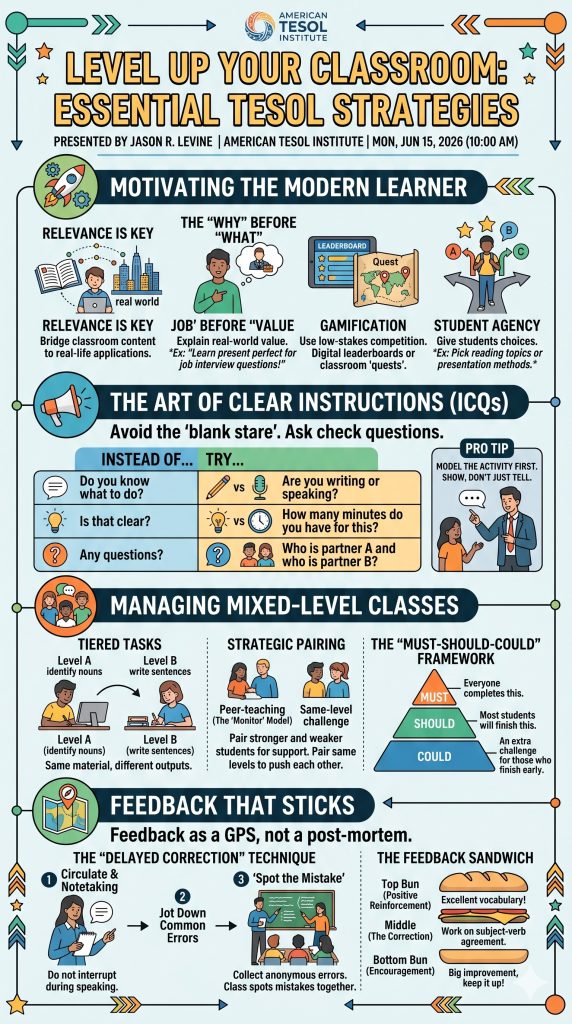
1. Motivating the Modern Learner
Motivation isn’t just about high energy; it’s about relevance. Students lean in when they see a bridge between the classroom and their real lives.
- The “Why” Before the “What”: Never start a lesson without explaining the real-world application. “Today we are learning the present perfect so you can talk about your life experiences in a job interview.”
- Gamification: Use low-stakes competition. Simple tools like digital leaderboards or classroom “quests” turn repetitive drilling into an engaging challenge.
- Student Agency: Give them choices. Let them pick between two different reading topics or three different ways to present a project.
2. The Art of Clear Instructions (ICQs)
One of the biggest hurdles in an ESL classroom is the “blank stare” after a teacher finishes explaining a task. To avoid this, move away from asking “Do you understand?”
Instead, use Instruction Checking Questions (ICQs):
| Instead of… | Try… |
| “Do you know what to do?” | “Are you writing or speaking?” |
| “Is that clear?” | “How many minutes do you have for this?” |
| “Any questions?” | “Who is partner A and who is partner B?” |
Pro Tip: Model the activity first. Don’t just tell them; show them by performing the first task with a high-level student.
3. Managing Mixed-Level Classes
In a perfect world, every student would be at the exact same level. In reality, you’ll likely have a “false beginner” sitting next to a “fluent but inaccurate” speaker.
- Tiered Tasks: Give the same core material but different outputs. While Level A students identify nouns, Level B students write descriptive sentences using those nouns.
- Strategic Pairing: Pair stronger students with weaker ones to encourage peer-teaching (The “Monitor” model), but occasionally pair students of the same level so the stronger ones can truly push each other.
- The “Must-Should-Could” Framework: * Must: Everyone completes this.
- Should: Most students will finish this.
- Could: An extra challenge for those who finish early.
4. Feedback that Sticks
Feedback should be a GPS, not a post-mortem. It needs to be timely and actionable.
The “Delayed Correction” Technique
During a fluency-based speaking activity, do not interrupt. If you stop a student to correct a preposition, you kill their confidence and flow. Instead:
- Circulate with a notepad.
- Jot down common errors you hear.
- After the activity, write 4–5 of these errors on the board (anonymously).
- Have the class “spot the mistake” together.
The Feedback Sandwich
When providing written feedback, balance is key:
- Positive Reinforcement: “Your use of vocabulary was excellent!”
- The Correction: “Work on your subject-verb agreement in the second paragraph.”
- Encouragement: “This is a big improvement over your last draft—keep it up!”
Final Thoughts
Great teaching isn’t about being the smartest person in the room; it’s about creating an environment where students feel safe enough to make mistakes. By refining your instructions, differentiating your tasks, and timing your feedback, you create a classroom that runs itself.
Ready to dive deeper? Join us for the full webinar, and explore certification courses at the American TESOL Institute!