

The field of English Language Teaching (ELT) is evolving faster than ever. Yesterday’s “best practices” are today’s mere baselines. If you are entering the field today—whether you are preparing to teach abroad, working locally with immigrant communities, or are simply curious about the science of language instruction—we’re here to provide more than just the standard playbook.
On January 27th at 10 AM EST, join renowned expert Jason R. Levine for a transformative webinar designed to bridge the gap between foundational TESOL history and the cutting edge of linguistic mastery.
This session will provide the necessary scaffolding to understand how language education has evolved, while explicitly premiering our new standard for the industry.
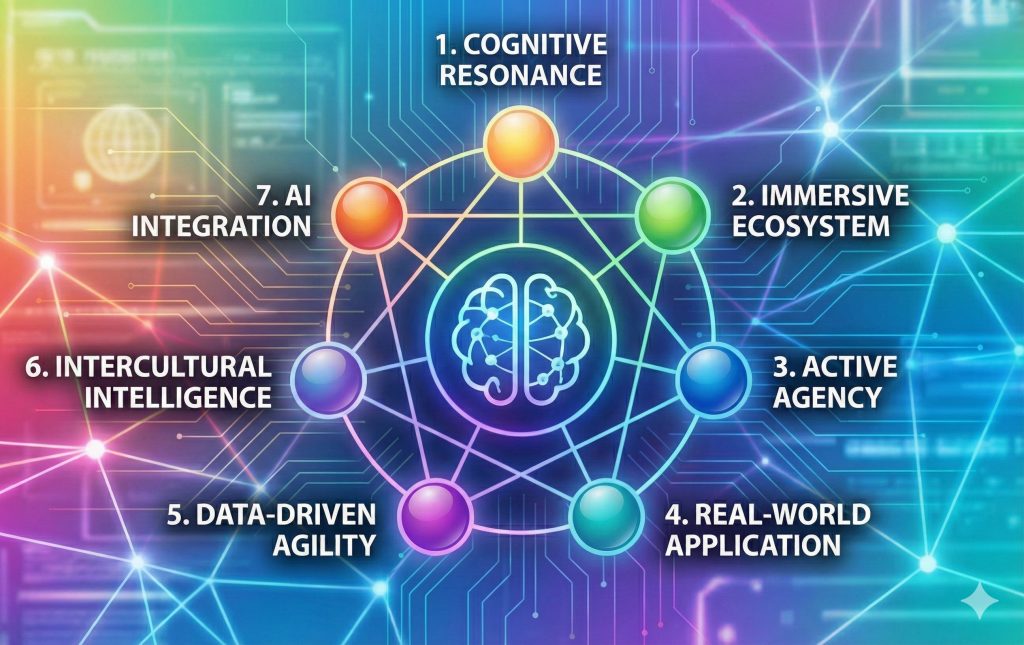
The American TESOL Framework: 7 Dimensions of Linguistic Mastery
While traditional models focus on teacher actions—like “knowing your learners” or “monitoring assessment”—The American TESOL Framework focuses on learner transformation. It is designed to be scientifically grounded, tech-forward, and results-oriented.
In this webinar, Jason will unpack these seven dimensions:
1. Cognitive Resonance & Identity Integration
- The Upgrade: Instead of just “knowing” the learner demographics, we align language learning with how the brain actually works and who the learner is.
- The Principle: Learning is most effective when it connects to the learner’s neurodiversity, cultural identity, and emotional drivers. We don’t just teach English; we integrate the language into the learner’s existing self-concept.
- The Strategic Shift: Focuses on Neuroscience and Psychology, not just demographics.
2. The Immersive Ecosystem (Physical & Digital)
- The Upgrade: “Creating conditions” is too vague for the modern era. We build an ecosystem.
- The Principle: Language acquisition happens everywhere. We design a seamless loop between the classroom, the digital space, and the real world. This includes psychological safety and high-stakes real-world practice simulations.
- The Strategic Shift: Explicitly includes Hybrid/Blended environments as a standard, not an add-on.
3. Active Agency & Metacognition
- The Upgrade: Traditional models focus on the teacher delivering. We focus on the learner driving.
- The Principle: We teach learners how to learn. By developing metacognition (thinking about thinking), we graduate students who are autonomous, lifelong learners who don’t rely solely on the instructor.
- The Strategic Shift: Shifts power from Teacher-Led to Learner-Driven.
4. Contextualized Real-World Application
- The Upgrade: Old models say “Design high-quality lessons.” We say “Design Reality.”
- The Principle: No language is taught in a vacuum. Every concept is immediately mapped to a real-world output (e.g., negotiating a deal, writing code comments, navigating a hospital). We prioritize Task-Based Learning (TBL) over grammar memorization.
- The Strategic Shift: Focuses on Output & Performance rather than “Lesson Planning.”
5. Data-Driven Agility (The Feedback Loop)
- The Upgrade: “Monitor and Assess” sounds like periodic testing. We use agility.
- The Principle: Assessment is not a distinct event; it is a continuous stream of data. We use formative feedback loops to pivot instruction instantly based on learner performance gaps. Agility refers to the ability to diagnose issues and course-correct immediately, rather than waiting for a final exam to reveal what was missed.
- The Strategic Shift: Agile Methodology applied to education.
6. Intercultural Intelligence (CQ)
- The Upgrade: Moving beyond a vague sense of “Community” to measurable “Competence.”
- The Principle: Language is a tool for culture. We embed Cultural Intelligence (CQ) into the curriculum, ensuring learners can navigate the nuance, humor, and hierarchy of the target language, not just the vocabulary.
- The Strategic Shift: Elevates the goal from “Fluency” to “Cultural Fluency.”
7. Technological Fluency & AI Integration
- The Upgrade: The “Force Multiplier” missing from traditional models.
- The Principle: We view technology and AI not as cheating, but as a lever for efficiency. We teach learners how to use translation tools, AI editors, and digital resources to accelerate their own acquisition and professional output.
- The Strategic Shift: Future-proofing the learner.
Laying the Groundwork: The Fundamentals
To truly appreciate the future, you must understand the past. This webinar is also designed as an essential primer for new students entering the field.
We will demystify the acronyms, break down the difference between “acquisition” and “learning,” and explore the rich history of methodologies—from the rigid structures of Grammar-Translation to the fluid dynamics of Communicative Language Teaching (CLT).
Foundational Topics Covered:
- The Alphabet Soup of ELT: Clearly distinguishing between TESOL, TEFL, TESL, ELT, and ELL to ensure you use professional terminology correctly.
- Historical Methodologies: A walk through the history of teaching styles, including:
- The Grammar-Translation Method (Classical roots)
- The Audio-Lingual Method (Behaviorist drills)
- The Communicative Approach (Meaning-focused interaction)
- Second Language Acquisition (SLA) Theory: Understanding how the brain actually acquires a new language, focusing on Stephen Krashen’s 5 Hypotheses (Input, Affective Filter, etc.).
- Lesson Planning Basics: The standard “PPP” (Presentation, Practice, Production) model versus newer task-based frameworks.
- Assessment Fundamentals: The difference between formative (ongoing feedback) and summative (final evaluation) assessment.
- Cultural Competence: Strategies for navigating the “hidden curriculum” and respecting the diverse cultural backgrounds students bring to the classroom.
Why Attend?
Entering the world of TESOL without a map can be overwhelming. This webinar serves as your compass, orienting you toward the best practices that define successful teaching today.
You will leave with a clear mental framework of the profession’s history, ready to dive deeper into specialized topics, and equipped with The American TESOL Framework to guide your career.