
The way the human brain processes written text is one of the most fascinating subjects in modern neuroscience. Unlike spoken language, which we are biologically hardwired to absorb naturally, reading is a completely human invention. Because of this, the brain has to literally rewire itself to make reading possible.
Understanding this complex cognitive process isn’t just for neuroscientists—it is essential for educators. Whether you are shaping a child’s first neurological pathways or helping an adult master English as a Second Language (ESL), knowing how the brain learns to read changes how we teach.
Here is a breakdown of the most incredible discoveries about what reading does to the brain, how it shapes development, and how we can apply this to teach ESL learners of all ages.
How Reading Rewires the Brain
Neuroscientists have used functional MRI (fMRI) scans to watch the brain read in real-time, leading to some stunning insights about our neural architecture.
- The brain recycles itself to read: Because human beings have only been reading for about 5,500 years, we haven’t evolved a dedicated “reading center” in the brain. Instead, the brain undergoes a process called neuronal recycling. It commandeers parts of the brain originally meant for object and face recognition and repurposes them to recognize letters and words.
- The creation of the “Letterbox”: As a child learns to read, a specific region in the left hemisphere (between the occipital and temporal lobes) physically changes to become the Visual Word Form Area (VWFA). This specialized area becomes a high-speed processor that instantly recognizes the shapes of words.
- Embodied Semantics: When you read a highly descriptive novel, your brain doesn’t just process the words as abstract concepts; it simulates the action. If you read the word “kick,” the motor cortex area responsible for leg movement physically lights up. Your brain essentially acts out the story internally as if you were experiencing it yourself.
- The “Wash-Out” effect: Studies show that reading a compelling novel causes measurable increases in brain connectivity, specifically in the regions associated with perspective-taking. These structural connectivity changes don’t just disappear when you close the book—they can persist in the brain for days afterward.
In clinical trials, when scientists test a new drug or treatment, they include a phase called a wash-out period. This is the time immediately after a patient stops taking a medication. Scientists observe the patient to see how long it takes for the drug to literally “wash out” of their system so their body can return to its normal baseline state.
When neuroscientists at Emory University conducted the landmark 2013 study that discovered this phenomenon, they treated reading a novel just like a medical intervention. They structured the experiment in three phases:
- Baseline: They scanned participants’ brains for 5 days before they started reading.
- Intervention: They had participants read a compelling thriller novel (Robert Harris’s Pompeii) for 9 days, scanning their brains each morning.
- Wash-Out: They took the book away and scanned the participants’ resting brains for 5 additional days to watch the cognitive effects “wash out.”
The surprise—and the reason this finding became so famous—was that the effects didn’t wash out right away.
Even though the participants were no longer reading, their brains maintained heightened connectivity, particularly in the regions associated with physical movement and perspective-taking. The neurological footprint of the story stubbornly lingered for days during a period when the brain was supposed to be returning to its baseline.
Reading and Child Development
When children learn to read—and when they are read to—it fundamentally alters their cognitive and emotional development.
- Building Brain Architecture: During the first few years of life, a child’s brain creates over a million new neural connections every second. Reading to young children provides the sensory input needed to strengthen the brain’s language circuitry. Because of synaptic pruning—where the brain eliminates unused pathways to improve efficiency—children who are consistently exposed to rich vocabulary and storytelling permanently lock in those high-functioning language pathways.
- Accelerating “Theory of Mind”: Around age 4 or 5, children develop “Theory of Mind”—the realization that other people have thoughts, feelings, and beliefs different from their own. Reading fiction significantly accelerates this. By putting a child inside the mind of a character who is experiencing fear, joy, or confusion, reading acts as a biological empathy simulator.
- Biological Stress Reduction: Reading with a child is not just an educational exercise; it’s a physiological intervention. Studies show that interactive reading with a caregiver actually lowers a child’s cortisol levels (the stress hormone). It is highly effective at slowing down the heart rate and calming the nervous system, establishing a sense of safety that is critical for healthy emotional development.
- The Matthew Effect: In developmental psychology, reading often follows the “Matthew Effect” (the rich get richer, the poor get poorer). Children who get an early, successful start in reading tend to enjoy it more, causing them to read more frequently. This increased volume of reading physically builds thicker white matter in the brain, which further accelerates their reading speed, vocabulary, and general cognitive intelligence.
The term “The Matthew Effect” takes its name from the biblical Gospel of Matthew, which states that those who have will be given more, while those who have not will lose even what they have—a concept often summarized as “the rich get richer, and the poor get poorer.” Originally coined in the 1960s by sociologist Robert Merton to describe how famous scientists receive disproportionate credit compared to unknown researchers, the term was adapted for education in 1986 by cognitive psychologist Keith Stanovich to explain the compounding cycle of reading development. Stanovich observed that children who grasp reading basics early find the activity enjoyable and read more frequently, which exponentially expands their vocabulary, background knowledge, and cognitive abilities. Conversely, children who struggle initially find reading frustrating and actively avoid it, causing them to miss out on crucial language growth and making future complex texts even more difficult to understand. Ultimately, Stanovich used this concept as a stark warning to educators: because reading is the primary vehicle for learning in school, a small initial gap in early decoding skills quickly compounds into a massive, lifelong deficit in overall intelligence, vocabulary, and academic success.
How to Teach ESL Learners to Read
When teaching English language learners, you aren’t just teaching a language; you are helping them build a new linguistic overlay onto their brain’s existing “letterbox.” Effective ESL reading instruction relies on a few core principles:
- Activate Prior Knowledge (Schema): Before reading a text, prime the learner’s brain. Discuss the topic, look at pictures, and predict what the text will be about. This gives their brain a framework to attach new English vocabulary to.
- Pre-teach High-Frequency Vocabulary: Don’t let unknown words disrupt the reading process. Introduce 5-7 key vocabulary words before they start reading to lower cognitive overload.
- Balance Intensive and Extensive Reading:
- Intensive reading involves dissecting short, difficult texts to understand grammar and precise vocabulary.
- Extensive reading involves reading longer, easier texts for pleasure and fluency. Both are required to build neural pathways.
- Use Scaffolding: Use graphic organizers, glossaries, and guided reading questions to support comprehension.
Teaching Reading: Adults vs. Children
Is there a different method for teaching an ESL child to read versus an adult? Absolutely. While the end goal is the same, their brains—and their lived experiences—require entirely different pedagogical approaches.
Teaching Children (Pedagogy)
Children are neurologically primed for rapid language acquisition, but they lack world experience and attention spans.
- Focus on Phonics and Decoding: Children are often learning the mechanics of reading for the very first time. They need explicit instruction in phonemic awareness (how sounds map to letters).
- High Engagement and Play: Use multisensory approaches—songs, Total Physical Response (TPR), colorful realia (real-world objects), and highly illustrated storybooks.
- Building the Habit: The goal is to build the “Matthew Effect” mentioned above. Short, frequent, and highly rewarding reading sessions are key.
Teaching Adults (Andragogy)
Adults already know how to read in their native language (usually). They don’t need to learn the concept of reading; they need to transfer their skills to a new language code.
- Leverage Transferable Skills: Teach them to use reading strategies they already know, such as scanning for specific information, skimming for the main idea, and using context clues.
- Focus on Relevance and Authenticity: Adults are motivated by practical application. Use real-world materials like news articles, emails, resumes, and menus rather than graded children’s books, which can feel patronizing.
- Respect the Affective Filter: Adults are often highly self-conscious about making mistakes. Lowering anxiety is crucial. Create a low-stakes environment where comprehension is prioritized over perfect pronunciation during reading exercises.
Fun Facts about Reading English
English is one of the only languages that conceptualizes reading not as gathering words, but as solving a puzzle. While Latin-derived terms like the French lire and Spanish leer—along with the German lesen—trace back to agricultural roots meaning to physically “gather” or “pick out” letters with the eyes, the English word follows a far more mystical path. It stems from the Proto-Germanic root and Old English word rædan, which originally meant to advise, counsel, or guess. Before the adoption of the Roman alphabet, Anglo-Saxons carved symbolic runes into wood and stone for brief inscriptions or divination. Because these symbols were heavily encoded, understanding them required active interpretation—you had to guess their secrets or “take counsel” from them. When Christian missionaries later introduced Latin manuscripts and the concept of the book, the Anglo-Saxons simply repurposed their existing word for interpreting mystical runes to describe this new technology, viewing the deciphering of ink on a page as the exact same mental process of unlocking a hidden code.
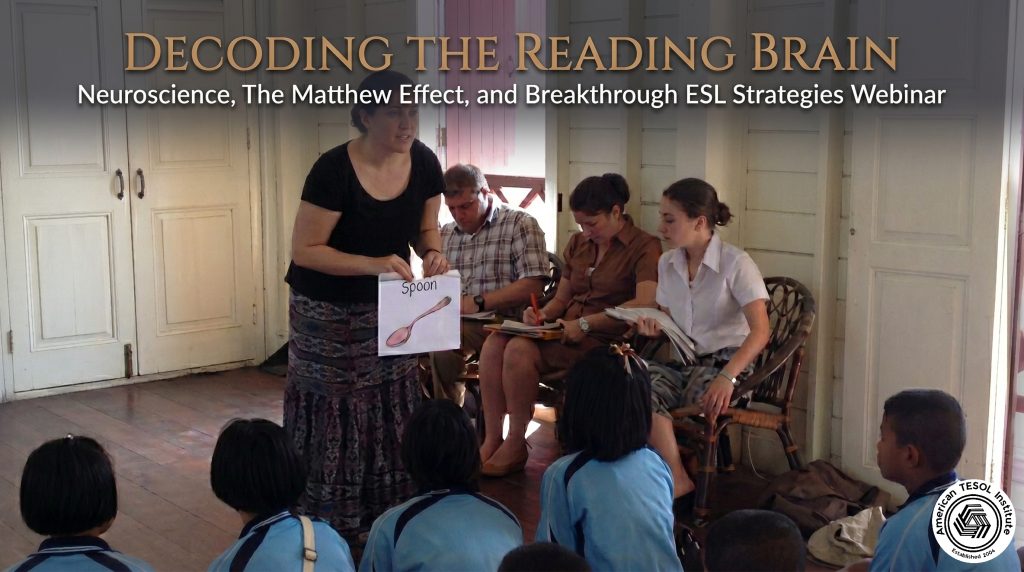
Upcoming Webinar: Teaching Reading Skills
Ready to dive deeper into these strategies and learn practical techniques for your classroom?
- Hosted by: American TESOL and Fluency MC
- Topic: Teaching Reading Skills
- Date & Time: July 16th at 10:00 AM EST
- Link: Join Live July 9th at 10AM New York Time
Whether you are teaching young learners decoding their first words or adults navigating complex texts, this webinar will equip you with the tools you need to build strong, confident readers. Don’t miss out on the chance to connect with experts and upgrade your teaching toolkit!