Linguistics and Architecture: How Languages Shaped Austin, Texas
Cities are readable records of the voices that built them. Every street grid, archway, and civic landmark reflects how a society organizes meaning, records laws, and communicates across generations. In Austin, Texas, the interplay between Indigenous North American languages, 18th- and 19th-century Copperplate and Spencerian cursive, and Standardized American English has left an unmistakable imprint across both historic neighborhoods and the modern skyline.
1. The Etymology of Austin: Naming the Landscape
Long before modern borders were drawn, the landscape around Austin was named and navigated through Indigenous North American languages, whose topographic descriptors anchored rivers, hills, and seasonal trails in collective memory.
Originally settled as the frontier village of Waterloo along the Colorado River in Tonkawa and Comanche territory, the Republic of Texas renamed its new capital Austin in 1839 to honor Stephen F. Austin, the 'Father of Texas,' fusing Anglo-American civic naming with Spanish-Mexican land-grant heritage.
2. History of Peoples and Spoken Languages
The streetscape of Austin, Texas evolved alongside successive waves of human settlement, trade, and linguistic exchange:
Indigenous & Earliest Linguistic Roots
The earliest communities in the Austin basin spoke Indigenous North American languages, encoding local ecology, waterways, and seasonal routes directly into the region's foundational vocabulary and geographic names.
Regional Trade & Classical Literary Traditions
As overland and maritime networks connected Austin to wider cultural spheres, classical literary and administrative languages introduced formal legal, religious, and architectural terminology into public life.
Historical Administration & Vernacular Evolution
Through centuries of civic growth, Colonial English, French, and Spanish shaped municipal governance, education, and local storytelling—giving rise to distinctive regional accents, idioms, and neighborhood identities across Austin.
Modern Cosmopolitanism & Global English
Today, Standardized American English anchors daily commerce, media, and university life in Austin, while English serves as a vital bridge for international education, tourism, and global career mobility.
3. Architectural Syntax: How Written Script Shaped the Skyline
Just as grammar governs how words connect into sentences, orthographic traditions—how a culture writes, spaces, and proportions its letters—mirror how its builders proportion facades, courtyards, and public squares.
From Heritage Script to Historic Landmarks
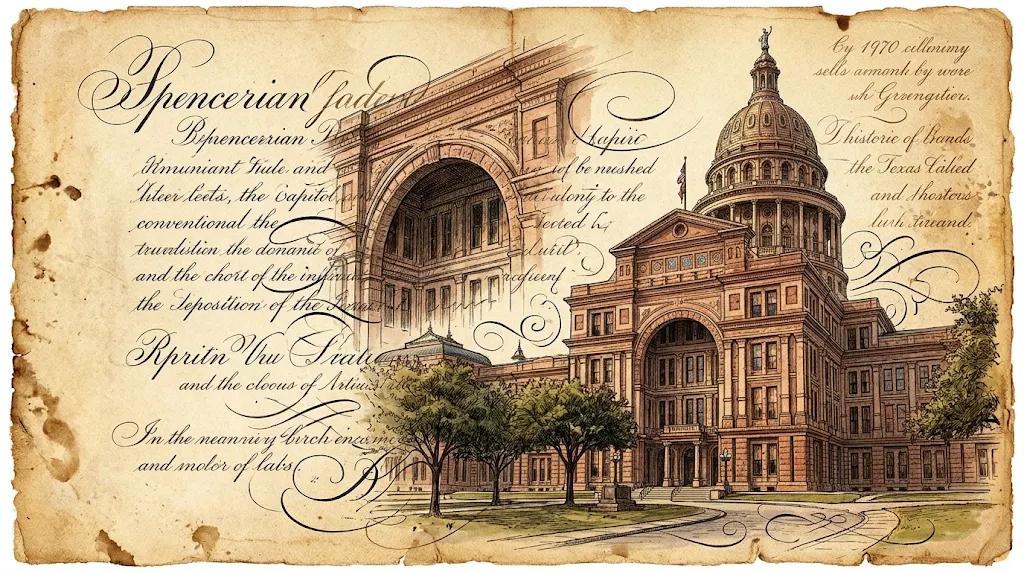
Historically, civic charters, scholarly manuscripts, and architectural inscriptions in Austin were crafted using 18th- and 19th-century Copperplate and Spencerian cursive—distinguished by flowing penmanship, balanced ascenders, and Classical Revival proportion books.
The heritage architecture of Austin translates that same orthographic rhythm into stone, brick, timber, and iron—most visibly across the sunset-red granite Renaissance Revival dome of the Texas State Capitol and historic Congress Avenue, where structural proportions echo the visual cadence of the written word.
Calligraphic & Structural Harmony: The stroke rhythm and spatial balance of historical writing traditions in Austin mirror the arches, facades, and craftsmanship of its heritage architecture.
Modern Language Dominance & Contemporary Skyline
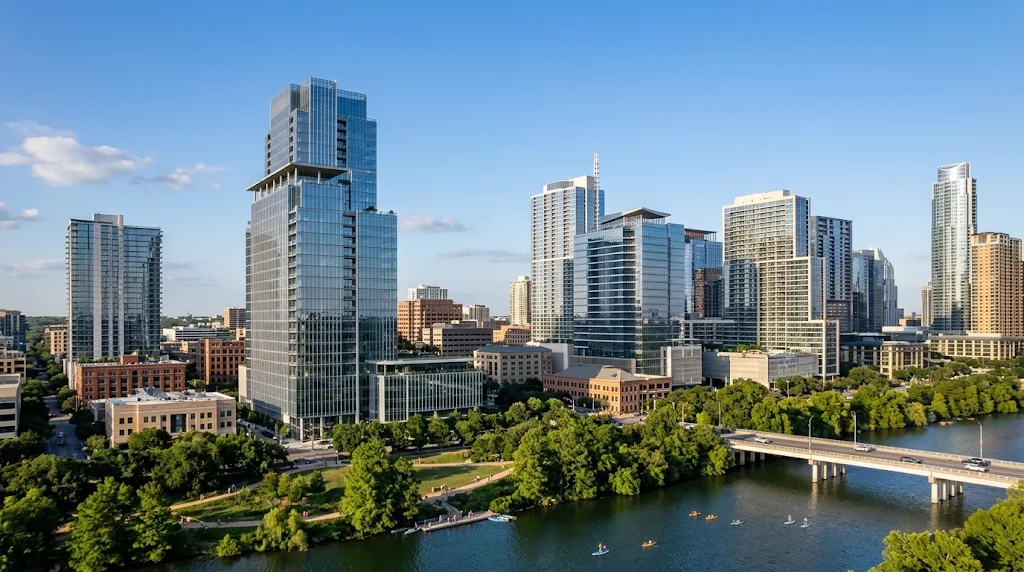
Today, Standardized American English and international English—expressed through bold Roman serif inscriptions and crisp modern sans-serif civic typography—dominate Austin's public signage, transit corridors, and digital communication, prioritizing clarity, speed, and universal legibility.
That contemporary linguistic clarity is reflected across the modern glass-and-steel towers of Downtown Austin and Lady Bird Lake, where clean geometric lines, curtain-wall glass, and modular steel express a modern, globally connected city built for scale.
Modern Visual Clarity: Standardized contemporary typography and the global reach of Standardized American English and English align with the clean geometric lines of Austin's modern skyline.
Love Languages and Culture? Build Your Future with TESOL Certification
Exploring Austin, Texas reveals a powerful truth: language isn't just something we speak—it is how communities connect, preserve heritage, and shape the world around them. If you are fascinated by how languages and cultures intersect, you can turn that passion into an international career.
With accredited TESOL Certification from the American TESOL Institute, you gain the practical classroom skills and global credentials needed to teach English in Austin, across United States, or online from anywhere in the world.