Linguistics and Architecture: How Languages Shaped Santiago, Chile
Cities are readable records of the voices that built them. Every street grid, archway, and glass tower reflects how a society organizes meaning, records laws, and communicates across generations. Nowhere is this interplay between language and physical space clearer than in Santiago, Chile—a metropolis shaped by indigenous Andean topography, Spanish colonial calligraphy, and the fast-moving rhythms of modern Chilean Spanish.
1. The Etymology of Santiago: Naming the Mapocho Valley
Before European arrival, the fertile basin framed by the Andes and the Chilean Coastal Range was anchored by the Mapocho River—a name derived from the indigenous Mapudungun words mapu ("land" or "earth") and chuco ("water that penetrates"), describing how the river disappears underground before resurfacing across the valley floor.
When Spanish conquistador Pedro de Valdivia founded a colonial settlement at the foot of Huelén Hill (renamed Cerro Santa Lucía) on February 12, 1541, he christened it Santiago del Nuevo Extremo ("Saint James of the New Frontier"). The name Santiago itself is a linguistic fusion: a contraction of the Latin Sanctus Iacobus (Saint James, patron saint of Spain) into Old Spanish Sant Yago. By pairing an Iberian saint's name with an existing Inca and Picunche administrative center, the city's very title established a bilingual foundation—layering European imperial order onto indigenous geography.
2. History of Peoples and Spoken Languages
Santiago’s streetscape evolved alongside distinct waves of human migration and linguistic exchange:
Picunche & Mapuche Foundations (Pre-1541)
The northern Mapuche people, known as the Picunche, cultivated the valley using irrigation canals (acequias) and spoke Mapudungun ("the speech of the land"). Their vocabulary still defines Santiago’s neighborhoods, hills, and waterways—from Vitacura ("large stone") to Apoquindo ("bouquet of flowers").
Inca Quechua Influence (Late 15th Century)
Prior to Spanish arrival, the southern expansion of the Inca Empire introduced Quechua administrative terms into the central valley, leaving enduring words in everyday Santiago speech such as chacra (small farm), guagua (baby), and cancha (open field or court).
Castilian Spanish & Colonial Isolation (1541–1810)
Spanish settlers imposed Castilian Spanish as the language of governance, Church doctrine, and urban planning. Separated from Spain by the Andes and the Atacama Desert, Santiago developed a distinctive, rapid-fire dialect—Chilean Spanish (castellano chileno)—marked by dropped final -s sounds, unique verb conjugations, and rich indigenous loanwords.
19th-Century European Cosmopolitanism (1818–1920)
Following Chilean independence, waves of French, British, German, and Italian immigrants, architects, and educators settled in Santiago. French became the language of high culture and civic design, while English shaped railway, mining, and commercial terminology.
3. Architectural Syntax: How Written Script Shaped the Skyline
Just as grammar governs how words connect into sentences, orthographic traditions—how a culture writes, spaces, and proportions its letters—mirror how its builders proportion facades, courtyards, and public squares.
From Flowing Spanish Calligraphy to Colonial Arcades
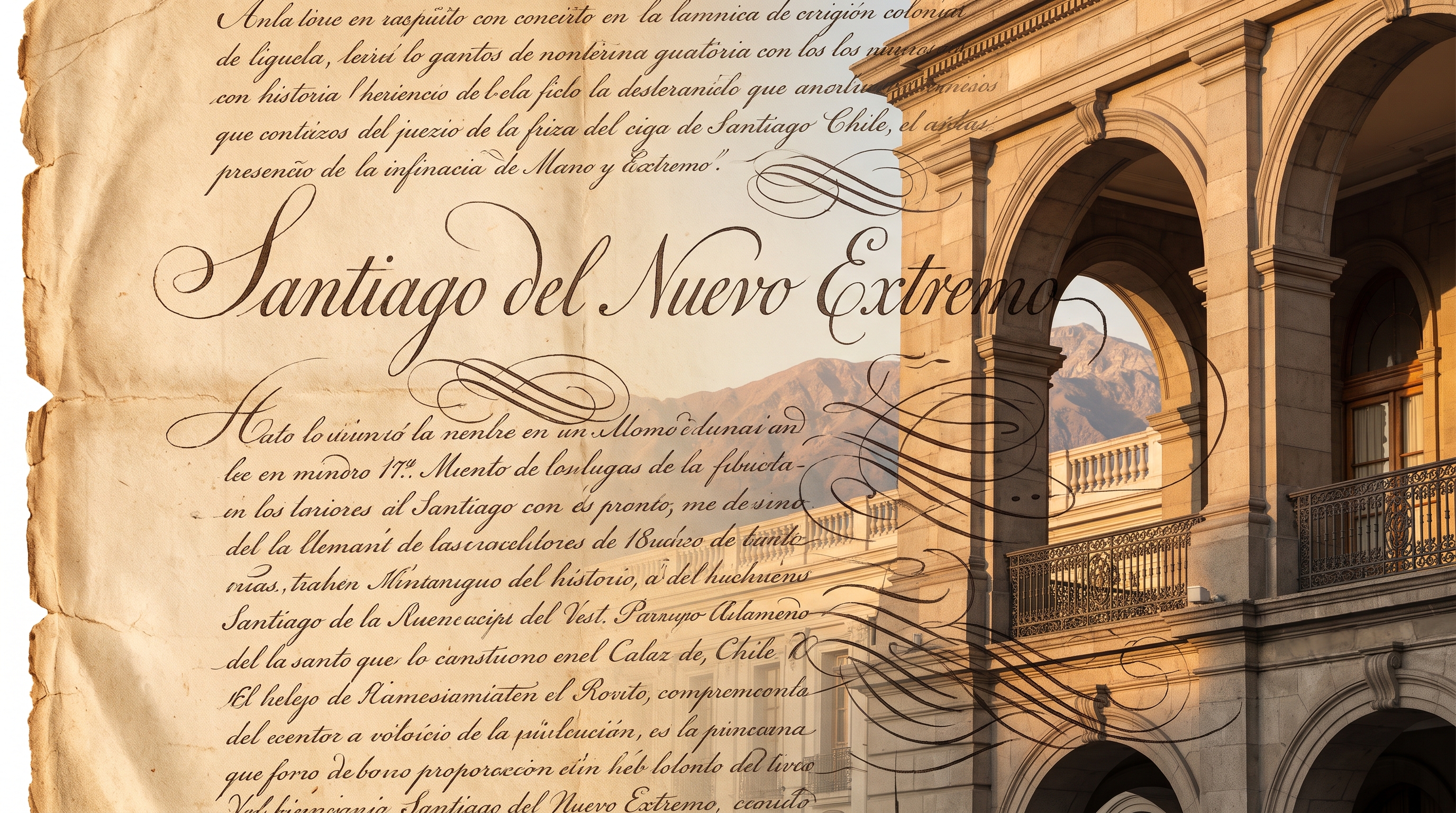
During the 17th and 18th centuries, Spanish legal decrees, land grants, and ecclesiastical records in Santiago were penned in flowing letra procesal and bastarda scripts—characterized by continuous, looping ligatures, rhythmic vertical strokes, and decorative flourishes that bound individual letters into unified lines.
Santiago’s heritage architecture translates that same calligraphic rhythm into stone, stucco, and wrought iron. Around the Plaza de Armas, in the neoclassical symmetry of Palacio de La Moneda (designed by Joaquín Toesca), and throughout the European-inspired curves of Barrio París-Londres, continuous arched colonnades (portales) and ornate iron balconies link separate storefronts into a single, sweeping visual sentence.
Calligraphic Continuity: The sweeping ligatures and rhythmic loops of 18th-century Spanish colonial script echo directly in the continuous stone colonnades (portales) and wrought-iron balconies of historic Santiago.
Modern Chilean Spanish & Contemporary Urban Verticality
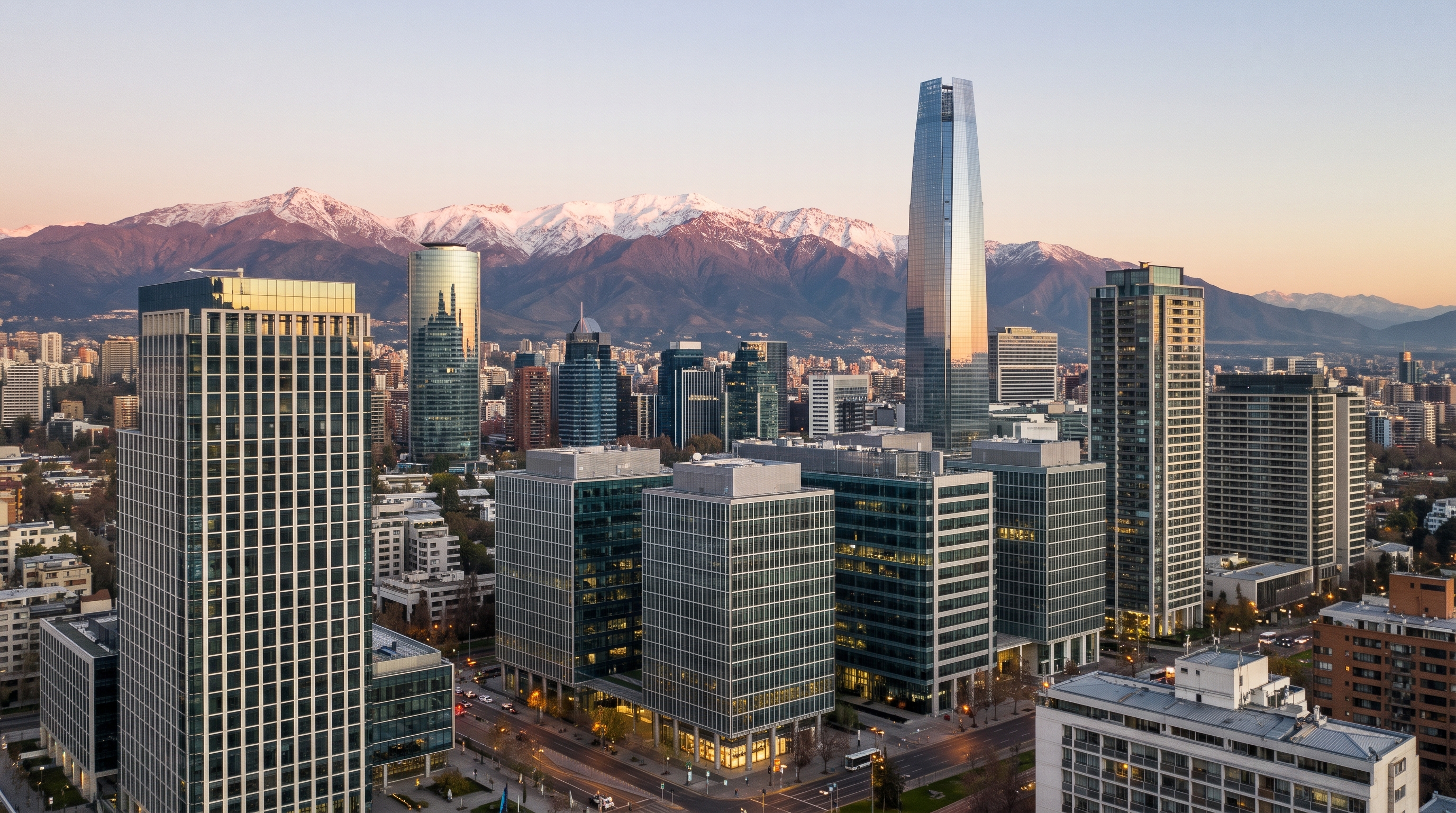
Today, standardized Latin typography and contemporary Chilean Spanish—paired with English as the global language of trade, technology, and higher education—dominate Santiago’s visual landscape. Clean, sans-serif signage, standardized street grids, and modular digital communication prioritize clarity, speed, and international legibility.
That linguistic shift is mirrored in the skyline of Providencia and Las Condes ("Sanhattan"), crowned by the Gran Torre Santiago. The ornate flourishes of colonial cursive have given way to crisp structural geometry, curtain-wall glass, and modular steel—reflecting a modern, globally connected city built for clarity and scale.
Modern Visual Clarity: Standardized sans-serif typography and the global reach of contemporary Chilean Spanish and English align with the clean geometric lines and glass curtain walls of Santiago’s modern financial skyline.
Love Languages and Culture? Build Your Future with TESOL Certification
Exploring Santiago reveals a powerful truth: language isn't just something we speak—it is how people connect, build communities, and shape the world around them. If you are fascinated by how languages and cultures intersect, you can turn that curiosity into an international career.
With accredited TESOL Certification from the American TESOL Institute, you gain the practical classroom skills and global credentials needed to teach English in vibrant cities like Santiago, across Latin America, or online from anywhere in the world.